
“He who knows no foreign languages knows nothing of his own.” (Goethe)
The Cost of Speaking Too Early
Why early output can interfere with real acquisition

This is it. You have decided, at last, to learn that language, for reasons that made perfect sense at the time and are now slightly blurry. You have been diligent. You followed the first lessons in the book. You did some of the grammar drills. But more importantly, you are on an impressive Duolingo streak, which is basically fluency gamified. You are, by any reasonable metric, doing great. Even more crucially, you have added yet another A1 flag to your Reddit profile. Identity has been updated. The world has been informed.
After watching approximately a gazillion beginner-friendly videos—each one promising you will “LEARN [insert language] IN 30 MINUTES”—you start catching words you vaguely remember seeing once. Progress feels alarmingly fast. Clearly, you are absorbing the language at an unprecedented rate. You know more than you did yesterday, far more than you did last week, and it doesn’t feel that hard just yet. Your motivation is high, which keeps you in the flow. You got it, you genius!
You happily spend at least an hour a day studying, probably even more because you are really into it, and frankly, time flies by. You feel confident that all these efforts will soon pay off and that you’ll be able to have short conversations that will justify all that hard work.
Well I hate to break it to you, but you are in fact on the rising curve of the Dunning-Kruger effect, and soon you’ll be collapsing. But for now, you aren’t aware of it and you feel that nothing can stop you from there.
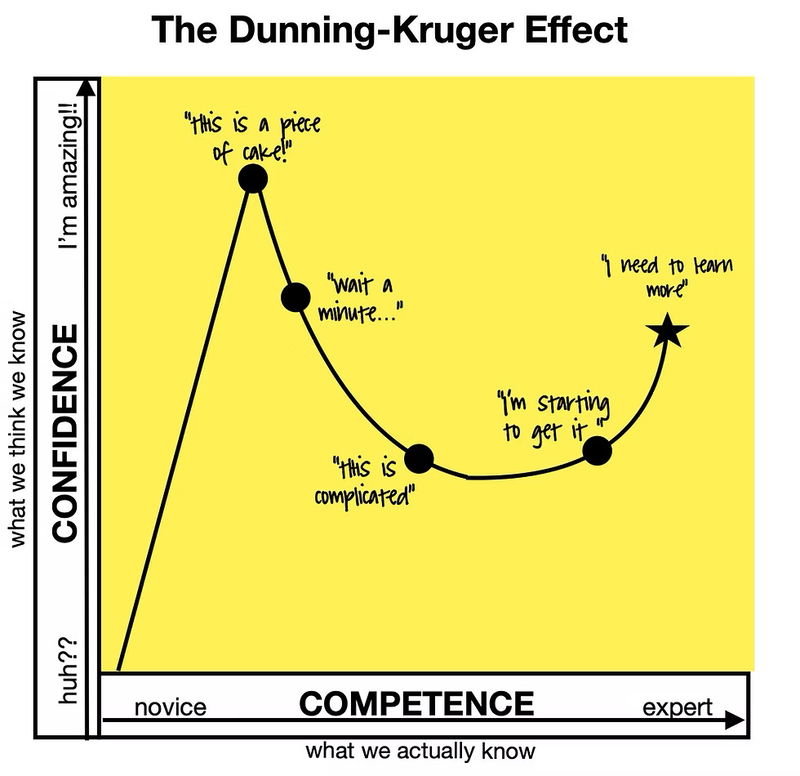
Words come to your mind quickly, you can already conjugate in the present, probably even in the past and future tenses, and when you throw in some adjectives and adverbs here and there, you feel invincible. Grammar bows before you; syntax fears you.
Surely this is is easy-peasy and you are so bright that you will nail that language in no time. Why most people spend years learning their target languages seems like a mystery. You are standing right at the peak of Mount Stupid (not my term), very confident in your ability to progress exponentially. After all, why shouldn’t your habits continue to pay off?
And this is when you begin to gradually fall off the top of the hill. (Told ya.) You’ve been so eager to put into practice everything you’ve learned so far - to communicate and/or to be praised (usually both)- that you have sped up the natural pace your brain needs to form and solidify those neural connections. (Turns out the brain does not respond well to being pressured). In doing so, you have already heard yourself make a bunch of mistakes with approximate pronunciation, excused yourself for lacking vocabulary, and tripped over grammar in the broadest sense of the term. And along the way, those early mistakes can settle in, becoming habits that are hard to undo later; a process known as fossilization.
In short, you have tried to run before you could walk, and now you are beginning to be afraid to toddle. And unless you have tried to talk with a tutor you were paying, or with a loved one who doesn’t mind the lack of substance of your exchanges (bless them), you have most likely bored everyone to death… if they haven’t already tried to switch to English, or simply disengaged altogether if what you’re learning is English.
Two reflexes seem especially hard to shake in language learning.
One is the impulse to rush ahead before the ground is ready, fueled by the brief exhilaration of hearing oneself produce words in a language that still feels new. A linguistic sugar rush, really.
The other grows right out of it: a kind of attachment to that rush, to the pleasure of being heard, noticed, sometimes even praised, instead of staying with the quieter work of listening to how native speakers actually speak, and paying attention to what they are saying rather than to the sound of one’s own voice. I know, that may sound a bit controversial, and mildly unflattering, but that is the feeling I get from so-called polyglots, both online and offline.
Of course, it is motivating to know that progress is happening, that all that tedious work is not going to waste. It is also reasonable to want to check whether we are on the right path, and practicing a bit certainly helps with that, or at least in theory. Because real-life conversations, or even conversations with AI bots (something you can now do with apps like Langua), are high-stress environments. They force you to speak about something fairly specific, within a limited amount of time, to keep the exchange going. But linguistic ping-pong gets tiring fast when the ball keeps coming back faster than expected.
When the language is still so new that it hasn’t settled into long-term memory, retrieving the right word, syntax, and pronunciation all at once becomes extremely difficult. It’s not even necessarily easy in one’s native language when asked to speak on a precise topic, which is essentially what language tutors make you do even in the early stages of learning, to give you a chance to make use of all the words and structures that you have learned. If stressful environments aren’t particularly kind to proficient speakers, you can easily predict the fiasco in the making when the learner knows very little of the language. As the linguist Stephen Krashen explained in his famous video on language acquisition in the 80s: “We acquire a language in one way and only one way, when we get more comprehensible input in a low anxiety environment.” And I will elaborate on the first part of his argument some other day.
I keep coming back to how much modern language learning distrusts the natural phases required to acquire a new language. There is a rush toward speaking, toward being heard. Silence is treated as hesitation, or worse, as avoidance. If you are not producing anything, you must not be learning. But that doesn’t quite match how the mind behaves when it is actually absorbing patterns. Perception seems to need time on its own, without the pressure to perform. It rearranges itself quietly.
As I discussed in another article, when you focus your energy on listening without feeling the urge to participate, intonation settles before words do. Rhythm arrives before accuracy. You notice how sentences breathe, where they tighten, where they loosen. You overhear conversations you don’t fully understand and still come away with a sense of how they moved. It’s a bit like listening to music from another room: the melody reaches you even when the lyrics don’t. Something registers anyway. You are not wasting your time. You are sowing the seeds for a strong tree, whose branches will be able to grow exponentially once the roots are sound.
Children are allowed this. They listen for years, accumulating sound without being asked to demonstrate much. And they aren’t expected to, because they simply aren’t capable of using their vocal cords properly yet. Their early speech is sparse, sometimes clumsy, but it rests on a dense foundation of familiarity. Adults, by contrast, are pushed straight into output. The result is speech that appears quickly but carries very little weight behind it. The accent lingers, the rhythm resists the natural flow. Sentences feel assembled rather than grown, and roots fail to take hold the way they should.
I don’t think this is a failure of effort. It’s more a question of reference. Without having heard enough, correction floats in the air. You’re told something is off -but off from what, exactly? The language has no internal anchor yet. Listening provides that anchor slowly, almost imperceptibly. Patterns repeat. Structures reappear. At some point, you stop noticing them consciously, which is usually when they start to work. Listening a lot instead of speaking right away is like preparing for an exam rather than winging it and hoping for the best.
Extended listening and reading do something strange to time. You don’t feel productive while you’re doing them, but later you realize that expressions and words come to mind before you actively search for them. Because you just know them. Somehow. For some reason. You anticipate turns of phrase. You recognize what is likely to come next. Speech, when it finally shows up, feels less like construction and more like recognition, as if you were stepping into something already prepared.
The first time I ever spoke English in a real-life situation, I was a few months shy of turning seventeen. My first class had been when I was around six, but aside from learning colours, animals, vegetables, and a few isolated words like window, I wouldn’t say I really learned anything until I was around eleven, when I had more formal classes three to four hours a week. Back then, there was almost no opportunity to practise or even listen to English. The internet as we know it didn’t exist, and films and series were only available on TV and were dubbed.
So I read, and read, and read everything I could find - from whatever I could get my hands on online to newspapers made for young English learners. I devoted a lot of time to consuming English without worrying about whether I was wasting my time or not. I was doing it with pleasure, and to this day I don’t remember ever learning lists of vocabulary. I learned in context, through intense exposure. And more importantly, I never doubted that I was progressing.
So when an elderly English couple asked me what time it was near a campsite, I answered with confidence. I knew, internally, that I could, even though I had never spoken to anyone “real” before. I remember distinctly that they congratulated me on my command of their language and my accent after the brief conversation that followed. That alone gave me all the motivation in the world to keep going. Within a week, I had made friends - mostly Dutch - and we had seamless conversations using words I had no idea where I had learned.
So the takeaway I am trying to share here is simple: take your time. If you don’t, you may completely jeopardize your learning for years, as happened to me with another language. (I will write about it some day). I know that the slow approach doesn’t look impressive from the outside. It doesn’t reward quick wins. It offers very few visible milestones. It asks for presence without display, attention without immediate reward.
But eventually, speaking does emerge - and it does so differently. Not urgently, not defensively. Sentences move with fewer interruptions. Pronunciation still needs work, of course, but it bends more easily. Grammar feels familiar, not because you can explain it, but because you’ve encountered it many times before. Pauses no longer signal confusion; they feel more like listening continuing inside the speech itself. There is always pressure to show progress, to prove that learning is happening. Silence makes people uneasy. But the brain seems unmoved by that discomfort. It keeps responding to repetition, to time spent close to the language, to the slow accumulation of sound and structure. The effects remain hidden until they don’t.
None of this feels passive to me. It feels patient, which is something else entirely. Not doing nothing, just not rushing in and messing with it too soon. Letting the language settle where it settles, without poking it every five minutes to see if it’s working just yet. The work happens quietly, without proof, without anything you could really point to, which is mildly unsettling but also kind of the point. And when speech finally comes out, it carries this odd sense of recognition, as if the language had already been there for a while and you’re only now catching up.

Comments
No comments yet. Be the first to comment!